
If you’re buying or selling a home in Denver, Colorado, you’ve probably asked the same question everyone asks first:
“What’s the average Realtor commission in Denver in 2026?”
The short version: commissions are still commonly in the 5%–6% range when a seller is effectively paying for both sides (listing + buyer agent), but the market is evolving quickly—especially after the industry changes that took effect in August 2024.
Below is a data-backed breakdown of what Denver sellers and buyers are actually seeing, how commissions work today, and the smartest ways to reduce fees without sacrificing results.
Quick Answer: Average Realtor Commission in Denver (2026)
Based on a September 2025 survey of local agents, the average total real estate commission in Denver is about 5.71%. (Source: Clever Real Estate, Denver commission survey)
That total typically represents the combined compensation for:
- Listing agent (the seller’s agent)
- Buyer’s agent (the buyer’s representative)
Important: “Average” doesn’t mean “standard.” Commissions are negotiable, and many transactions come in below 6%—especially when sellers compare options and negotiate up front.
Sources:
Denver commission survey (Clever) |
Colorado commission context (Bankrate) |
National commission context (HomeLight)
How Realtor Commission Works in Denver
In a traditional transaction, total commission is calculated as a percentage of the final sale price (not the list price):
Final Sale Price × Commission % = Total Commission
Typical “Traditional” Split
Historically, Denver commissions often break out roughly like this:
- Listing side: ~2.5%–3.0%
- Buyer side: ~2.5%–3.0%
But 2026 is different in one key way: how buyer-agent compensation is discussed and documented has changed across the industry, and that’s influencing negotiation and pricing.
What Changed After 2024 (And Why It Matters in 2026)
Beginning August 17, 2024, significant industry practice changes took effect nationwide that directly impact how buyer agent compensation is handled.
Two major changes matter most for Denver buyers and sellers:
1) Buyer Representation Agreements Now Clearly State Agent Compensation
When a buyer works with an agent, the written buyer representation agreement must clearly outline how that agent will be compensated. In other words, the agreement specifies the commission amount or percentage the buyer’s agent is expecting to earn.
If a seller is not offering compensation — or is offering less than what is stated in the buyer’s agreement — the buyer may be responsible for paying the difference.
This is a major shift in transparency. Buyers must now fully understand:
- What commission their agent is expecting to receive
- Whether that amount is negotiable
- What happens if the seller does not cover that compensation
- Whether they could owe money out-of-pocket at closing
It is critical that buyers have this discussion with their agent BEFORE signing a representation agreement.
2) Offers of Compensation Are No Longer Displayed in the MLS
Compensation to buyer agents is no longer displayed in MLS fields the way it historically was. That means commission offers are not automatically visible within MLS listings.
Instead, compensation is negotiated more directly between parties and addressed in contracts and written agreements.
This does not mean sellers cannot contribute toward buyer agent compensation. It simply means:
- Compensation is no longer preset inside MLS listings
- Terms are negotiated more transparently
- Buyers and sellers must understand how commission is structured before entering a contract
For buyers in 2026, clarity upfront is essential. Understanding how your agent is paid — and who ultimately covers that cost — should be one of the first conversations you have when beginning your home search.
For a full legal breakdown of how rebates and compensation work in Colorado, read Are Buyer Commission Rebates Legal in Colorado?.
Sources:
NAR: Written buyer agreements (Aug 17, 2024) |
NAR: Practice change reminder (Aug 2024) |
Axios Denver: New commission rules overview
Real Numbers: What a 5.71% Commission Looks Like in Denver
Let’s make the commission math real.
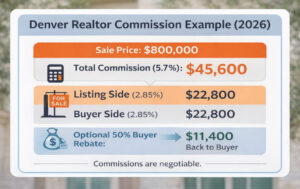
Example of how a 5.7% total Realtor commission breaks down on an $800,000 Denver home in 2026, including a potential 50% buyer rebate.
Example: $700,000 Denver Home
- Total commission (5.71%): $39,970
- If split evenly (example only): ~$19,985 per side
Example: $1,000,000 Denver Home
- Total commission (5.71%): $57,100
- If split evenly (example only): ~$28,550 per side
That’s why commission structure matters: even a 1% change at Denver price points can be a five-figure difference.
Why Your Personal Experience Might Be Lower Than the “Average”
If you’ve been seeing lower totals (especially closer to 5% or below), you’re not imagining it. The Denver market has a wide range of outcomes because:
- Discount / low-fee models are more common than they used to be
- Some sellers negotiate down aggressively
- Some homes sell with different buyer-agent arrangements
- Pricing varies by price point (higher price homes often see lower percentages)
So the “average” (like 5.71%) reflects the blend of traditional listings and negotiated/alternative models.
Can You Negotiate Realtor Commission in Denver?
Yes—commissions are negotiable in Denver. Many consumers successfully negotiate fees, especially when they compare options and clarify exactly what services are included.
In fact, consumer surveys show many people who ask for a lower rate are successful. (Source: HomeLight commission overview)
Source:
HomeLight: Commission overview + negotiation data
How Denver Sellers Can Save on Realtor Fees in 2026
Here are the most common (and practical) ways Denver sellers reduce commission costs:
1) Choose a Low-Fee or Discount Listing Model
Some sellers opt for models like:
- 1% listing fee (instead of ~2.5%–3%)
- Flat-fee or tiered service packages
2) Negotiate Up Front (Before You Sign)
Ask direct questions:
- What is your total commission?
- How much goes to the buyer side?
- What marketing is included (photos, video, ads, staging consult)?
- Is there a performance-based structure (bonus only if we exceed a target)?
3) Be Strategic With Buyer-Agent Compensation
In 2026, more transactions involve negotiating buyer agent compensation in writing. Sellers may:
- Contribute toward buyer-agent fees to attract buyers
- Use concessions strategically (especially if rates are high)
- Evaluate what’s competitive for their price point and neighborhood
How Denver Buyers Can Save in 2026
In 2026, buyer agent compensation is no longer something most buyers can ignore. Because buyer representation agreements now clearly outline how an agent is paid, buyers need to understand the structure of that compensation from day one.
The good news? There are legitimate and strategic ways Denver buyers can reduce costs — or even receive money back at closing — when the transaction is structured properly.
1) Negotiate Buyer-Agent Compensation Upfront
Before signing a buyer representation agreement, buyers should discuss:
- What commission percentage or amount is being agreed to
- Whether that amount is negotiable
- What happens if the seller offers less than that amount
- Whether any portion of the commission could be credited back to the buyer
Clarity upfront prevents surprises later.
2) Use Seller Concessions Strategically
In many Denver transactions, sellers may offer concessions that can be used toward allowable closing costs, prepaid items, or rate buydowns (subject to lender guidelines).
This can reduce a buyer’s out-of-pocket expenses — especially in higher price ranges where closing costs are significant.
3) Work With a Buyer Commission Rebate Model
If you want a deeper explanation of how rebates work with real numbers, see How Does a 50% Realtor Rebate Work?.
In a traditional transaction, if a seller offers compensation to a buyer’s agent, that compensation is paid in full to the brokerage. However, in a rebate model, a portion of that commission is credited back to the buyer at closing (where permitted and properly disclosed).
This rebate can often be applied toward:
- Allowable closing costs
- Prepaid taxes and insurance
- Interest rate buydowns
- Other lender-approved expenses
On higher-priced Denver homes, this can represent thousands — sometimes tens of thousands — of dollars returned to the buyer.
For example:
- $800,000 purchase × 2.8% buyer-side commission = $22,400
- 50% rebate = $11,200 credited back to the buyer (subject to lender approval)
With rising home prices across the Denver metro area, understanding how commission works — and whether a rebate model is available — can materially impact your net cost of buying.
If you want a full breakdown of how rebates work in Colorado, including legality, lender rules, and real examples, see:
Buyer Commission Rebates in Colorado (Complete Guide)
Featured Snippet FAQ: Average Realtor Commission in Denver (2026)
What is the average Realtor commission in Denver in 2026?
Based on a September 2025 survey of local agents, the average total real estate commission in Denver is about 5.71%, though commissions vary widely and are negotiable.
Is there a “standard” commission in Denver?
No. There is no legally required standard commission rate. Commission is negotiable and depends on the brokerage model, services provided, and local competition.
Do sellers still pay the buyer agent commission in 2026?
Often, sellers still contribute toward buyer-agent compensation, but the process is more transparent and negotiated directly due to industry rule changes that began in August 2024.
How can I pay less than the average commission in Denver?
Compare listing models (including low-fee options), negotiate upfront, and make sure you understand exactly what’s included in the agent’s services and marketing plan.
Conclusion: Denver Realtor Commissions in 2026
In 2026, many Denver transactions still land in the 5%–6% total commission range when a seller effectively pays for both sides. But the market is changing—and buyers and sellers have more options than ever to structure fees intelligently.
If you’re selling, the best move is simple: get clarity up front and compare models side-by-side so you don’t overpay for an outdated commission structure.
Want to sanity-check your specific scenario? The commission math changes fast based on price point, neighborhood, and the terms you want. Reach out and we’ll map out the smartest fee structure for your Denver home.
If you’re comparing traditional commissions vs lower-fee models, you may also want to review your options with a Discount Realtor in Denver before listing.