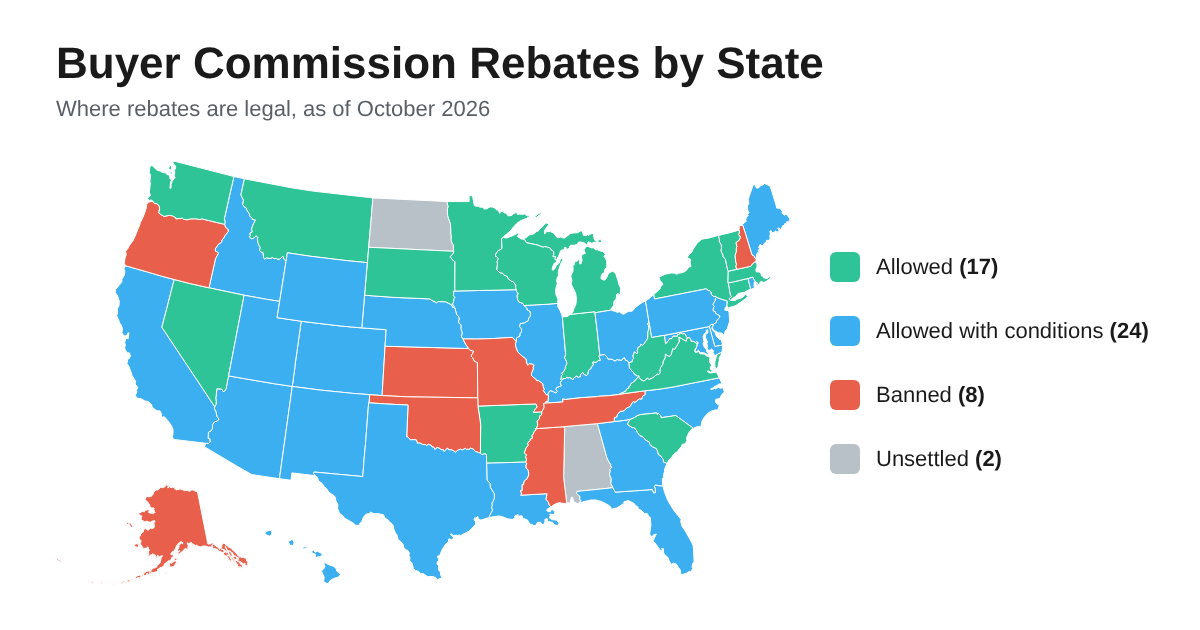
The short answer: a buyer commission rebate is money your agent gives back to you from their commission, usually as a credit at closing. As of October 2026 it is allowed in 40 states and Washington, DC, banned in 8 states, and unsettled in 2. The full state-by-state table, with the law behind each answer, is below.
What is a buyer commission rebate?
When you buy a home, your agent is paid a commission, often a percentage of the price. A buyer commission rebate is when the agent agrees to give part of that commission back to you. Some agents share a small amount. Others, including some brokerages built around rebates, share a large portion.
A rebate is not a discount on the home and it does not come from the seller. It comes out of your agent’s own pay. That is why the size of the rebate depends on two things: how much commission your agent is paid, and how much of it they agree to share.
How a rebate works, start to finish
- It is agreed in writing up front. Before you start, your agent puts the rebate terms in writing so there is no question later about what you will receive.
- If you are financing, your lender approves it. The lender has to know about the rebate and sign off on it. Most loan programs allow it as a credit toward your closing costs and prepaid items, and many limit how much can be credited.
- If you are paying cash, it can be paid as cash. With no lender involved there is no approval step. The rebate can come to you as cash on your settlement statement. It still has to be fully disclosed there.
- It is always paid through closing. The rebate appears on your Closing Disclosure or settlement statement as a credit from your agent’s brokerage. It should never be paid to you separately, outside of closing. An undisclosed payment can break your lender’s rules and, in some states, real estate law.
In most states that allow rebates, the rules come down to those same three ideas: put it in writing, disclose it to everyone involved, and run it through closing. Some states add their own requirements, which are noted in the table below.
How much is a buyer commission rebate worth?
The math is simple. Multiply the price by the commission rate, then by the share your agent rebates. This table assumes a 2.8% buyer’s agent commission and a 50% rebate. Commissions are negotiable and vary by market, so treat these as illustrations, not quotes.
| Home price | Buyer’s agent commission at 2.8% | 50% rebate to you |
|---|---|---|
| $400,000 | $11,200 | $5,600 |
| $600,000 | $16,800 | $8,400 |
| $750,000 | $21,000 | $10,500 |
| $1,000,000 | $28,000 | $14,000 |
| $1,500,000 | $42,000 | $21,000 |
To run your own numbers, try our rebate savings calculator.
Is a buyer commission rebate taxable?
The IRS has treated payments from a real estate brokerage to a home buyer as a reduction in the purchase price, not as income. In Private Letter Ruling 202047002 (August 2020), the IRS said such payments were adjustments to the price of the home and did not need to be reported on a Form 1099. It relied on the same reasoning it applies to other buyer rebates, such as down payment assistance in Revenue Ruling 2006-27.
A private letter ruling only binds the taxpayer who requested it, and a lower purchase price can affect your cost basis when you sell. Talk to a tax professional about your own situation.
Can my lender limit the rebate?
Yes. Your lender decides how much credit it will allow at closing. Many loan programs cap credits from parties to the sale and do not allow cash back beyond your closing costs and prepaid items. If the credit would be larger than your lender allows, ask about applying it to other costs the program permits. Tell your lender about the rebate early, before you are under contract.
Buyer commission rebate laws by state
Not legal advice. State real estate laws and commission rules change, and they are interpreted differently by different regulators. This guide reflects our review of each state’s statutes, rules and published guidance as of October 21, 2026, with the source linked for every state. It is general information, not legal or tax advice, and it may already be out of date. EZ Agents is licensed in Colorado only. Before relying on a rebate in any other state, confirm the current rules with that state’s real estate commission or a licensed agent or attorney there.
States that ban rebates: Alaska, Kansas, Mississippi, Missouri, New Hampshire, Oklahoma, Oregon, Tennessee. Unsettled: Alabama and North Dakota. Every other state and DC allows rebates, many with conditions.
| State | Status | What to know | Law |
|---|---|---|---|
| Alabama | Unsettled | Law bans "rebates" but the commission allows disclosed buyer incentives at closing. Unsettled, confirm with AREC. | Source |
| Alaska | Banned | Commission share to an unlicensed person, including your own client, is prohibited. | Source |
| Arizona | Allowed, with conditions | Paid through escrow on written instructions, disclosed to all parties and the lender. | Source |
| Arkansas | Allowed | No prohibition found. Lender approval and closing statement rules apply. | Source |
| California | Allowed, with conditions | No ban. Lender must agree and the credit appears on the Closing Disclosure. | Source |
| Colorado | Allowed, with conditions | Allowed by Commission position. Lender approval, on the settlement statement, never outside closing. | Source |
| Connecticut | Allowed | No prohibition found. Lender approval and closing statement rules apply. | Source |
| Delaware | Allowed, with conditions | Expressly allowed. Must be disclosed to the client in writing. | Source |
| District of Columbia | Allowed | No prohibition found. Rebate goes to the client, not a third party. | Source |
| Florida | Allowed, with conditions | Allowed with full disclosure to all interested parties. | Source |
| Georgia | Allowed, with conditions | Only to the agent’s own client, shown on the closing statement. | Source |
| Hawaii | Allowed, with conditions | Allowed. Must be in writing and offered by the brokerage. | Source |
| Idaho | Allowed, with conditions | Paid directly to the buyer or seller, without misleading the lender or title company. | Source |
| Illinois | Allowed, with conditions | Expressly allowed to a party to the contract. Conditions must be disclosed. | Source |
| Indiana | Allowed | No prohibition found. Closing statement and lender rules apply. | Source |
| Iowa | Allowed, with conditions | Allowed to buyers since a 2024 rule change, with disclosure, to the broker’s own client. | Source |
| Kansas | Banned | Statute bars any rebate, disclosed or not. The 2020 repeal effort did not pass. | Source |
| Kentucky | Allowed, with conditions | Expressly allowed. The rebate agreement with the client must be in writing. | Source |
| Louisiana | Allowed, with conditions | Statute bars only undisclosed rebates. Disclose in writing to all parties. | Source |
| Maine | Allowed, with conditions | Allowed as an inducement if not deceptive, with conditions clearly disclosed. | Source |
| Maryland | Allowed, with conditions | Must be offered to all clients on the same terms and put in writing. | Source |
| Massachusetts | Allowed | Allowed to the buyer or seller only. Shown on the Closing Disclosure. | Source |
| Michigan | Allowed | Allowed to the client. Payments to unlicensed referrers are not. | Source |
| Minnesota | Allowed | Statute expressly allows payments to the parties to the transaction. | Source |
| Mississippi | Banned | Statute bars paying any rebate to a non-licensee. | Source |
| Missouri | Banned | Statute bars money or gifts conditioned on a purchase. No disclosed-rebate exception. | Source |
| Montana | Allowed | Rules expressly allow payments to principals. Do not misstate the price to the lender. | Source |
| Nebraska | Allowed, with conditions | Allowed if disclosed in writing. Undisclosed rebates are an unfair practice. | Source |
| Nevada | Allowed | No prohibition found. Rebate goes to the client, not for services. | Source |
| New Hampshire | Banned | Statute bars giving over $100 in value to an unlicensed person, clients included. | Source |
| New Jersey | Allowed, with conditions | Buyers only, paid by the broker, agreed in writing and disclosed to the lender. | Source |
| New Mexico | Allowed, with conditions | Allowed to the client or a party, with the client’s written consent. | Source |
| New York | Allowed | Expressly allowed by statute since 2014. Lender must allow it. | Source |
| North Carolina | Allowed, with conditions | Disclosed to the lender and on the closing statement. Never paid outside closing. | Source |
| North Dakota | Unsettled | Statute bars paying unlicensed persons, with no guidance on buyer rebates. Confirm with the commission. | Source |
| Ohio | Allowed, with conditions | Must be disclosed, ideally in the purchase contract. | Source |
| Oklahoma | Banned | Statute bars sharing commission with unlicensed persons and purchase inducements. | Source |
| Oregon | Banned | Statute bars rebates to anyone unlicensed. A 2020 lawsuit did not change it. | Source |
| Pennsylvania | Allowed, with conditions | Allowed if disclosed. Undisclosed rebates are prohibited. | Source |
| Rhode Island | Allowed, with conditions | Allowed if disclosed. Undisclosed rebates are prohibited. | Source |
| South Carolina | Allowed | No prohibition on a rebate to a party to the transaction. | Source |
| South Dakota | Allowed | Commission guidance allows rebates and truthful advertising of them. | Source |
| Tennessee | Banned | Statute bars cash rebates. Non-cash gifts only under strict rules. | Source |
| Texas | Allowed, with conditions | Allowed to the agent’s own client. Ads must carry required disclosure language. | Source |
| Utah | Allowed, with conditions | Allowed as an inducement if the loan’s underwriting guidelines permit it. | Source |
| Vermont | Allowed | Rule expressly allows sharing commission to benefit the buyer or seller. | Source |
| Virginia | Allowed | No law or rule prohibits it. Paid through the brokerage. | Source |
| Washington | Allowed | No restriction found. Disclose to the lender in writing. | Source |
| West Virginia | Allowed | Allowed to the agent’s own client only. | Source |
| Wisconsin | Allowed | No prohibition found. Compensation disclosure rules apply. | Source |
| Wyoming | Allowed, with conditions | Allowed if disclosed. Undisclosed rebates are prohibited. | Source |
On a phone, swipe the table sideways to see every column. Each state verified October 21, 2026.
Found your state? Looking for a rebate realtor there?
Tell us where you are buying and we will see if we can help.
If your state bans rebates
A ban on rebates is not a ban on paying less. Commissions are negotiable in every state. Where rebates are banned, the usual route is to negotiate a lower buyer’s agent fee before you start. Talk it through with any agent you interview: ask what they charge, what your state allows, and how the savings will actually reach you.
How to choose a rebate agent
A rebate only matters if the agent behind it does the job well. Before you sign with anyone, ask:
- How exactly is the rebate calculated? A percentage of the commission, a flat amount, or a sliding scale, and whether there is a minimum fee.
- How is it paid? It should be paid through closing and shown on your settlement statement, with your lender’s approval if you are financing.
- What services are included? Some discount and rebate agents cut services to make the numbers work. That can mean no in-person showings, limited help with negotiation or inspections, or extra fees for things a full-service agent would handle. Ask for the full list of what you get.
- Who will actually work my deal? Find out whether you will work with one experienced agent or be passed between team members.
- Is it in writing? The rebate terms should be in your agreement before you start looking.
Not buying in Colorado?
Looking for a rebate realtor in your state?
Tell us where you are buying and we will see if we can connect you with a rebate agent there. No cost and no commitment.
"*" indicates required fields
Buying in Colorado? EZ Agents is a full-service real estate company that rebates 50% of the buyer’s agent commission to our buyers across Denver, Boulder and the Front Range. See how our Colorado rebate works.
Frequently asked questions
Is a buyer commission rebate legal?
In most of the country, yes. As of October 2026, rebates are allowed in 40 states and Washington, DC, banned in 8 states, and unsettled in 2. Many states that allow them require written disclosure and that the rebate appear on the closing statement.
Is a commission rebate taxable?
The IRS has treated payments from a real estate brokerage to a home buyer as a reduction in the purchase price rather than income, most recently in a 2020 private letter ruling. That ruling only binds the taxpayer who asked for it, so confirm your situation with a tax professional.
How do I receive a buyer commission rebate?
Usually as a credit on your Closing Disclosure. The credit lowers the cash you bring to closing. Your lender has to approve it, and many loan programs limit a credit to your closing costs and prepaid items.
How much is a typical buyer commission rebate?
It depends on the commission and how much of it your agent shares. At a 2.8% buyer’s agent commission and a 50% rebate, a $750,000 home returns $10,500.
What if my state bans rebates?
You can still negotiate a lower buyer’s agent fee before you start, which lowers what you pay without a rebate. Confirm what is allowed with your state’s real estate commission.
Disclaimer. State real estate laws and commission rules change, and they are interpreted differently by different regulators. This guide reflects our review of each state’s statutes, rules and published guidance as of October 21, 2026, with the source linked for every state. It is general information, not legal or tax advice, and it may already be out of date. EZ Agents is licensed in Colorado only. Before relying on a rebate in any other state, confirm the current rules with that state’s real estate commission or a licensed agent or attorney there. Tax information is general and not tax advice.