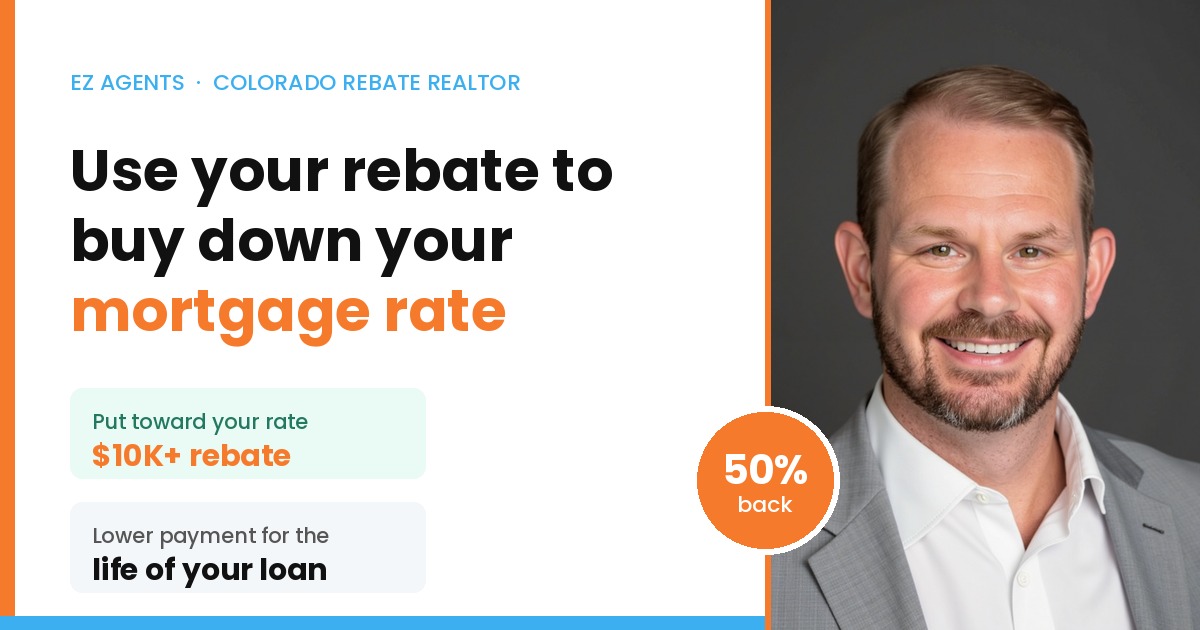
Short answer: Your buyer commission rebate shows up as a credit on your Closing Disclosure. It’s applied to allowable closing costs first, and if there’s money left over, you can often put it toward a mortgage rate buydown — lowering your interest rate and your monthly payment — subject to your lender’s approval. On a typical Colorado purchase, that can turn a $10K+ rebate into a real, lasting reduction in what you pay each month.
Most buyers think of a commission rebate as a way to cover closing costs — and it is. But in a higher-rate environment, one of the smartest uses is putting whatever’s left toward buying down your interest rate. Done right, that’s a benefit you feel every month for as long as you own the home.
Here’s how it actually works, step by step, and how to set it up so nothing gets left on the table.
First, what a rate buydown actually is
Buying down your rate means paying money up front, at closing, to secure a lower interest rate on your mortgage. There are two main types:
- Permanent buydown (discount points). You pay for discount points at closing and your rate is lowered for the entire life of the loan. As a rule of thumb, one point costs about 1% of the loan amount and lowers the rate by roughly 0.25% — though the exact numbers vary by lender and market.
- Temporary buydown (like a 2-1). Your rate is reduced for the first year or two, then steps up to the full note rate. Useful for early-year payment relief, but the savings don’t last the life of the loan.
For most buyers using a rebate, a permanent buydown tends to offer the most lasting value — but which makes sense depends on your loan, how long you plan to stay, and your lender’s guidance.
How the rebate gets applied
This is the part buyers most often get wrong, so it’s worth being precise:
- Your rebate appears as a real estate commission credit on your Closing Disclosure.
- It’s applied to allowable closing costs first — lender fees, title, escrow, prepaid taxes, and similar items.
- If your closing costs are already covered, the remaining funds can often be applied toward a rate buydown (discount points), subject to your lender’s approval and any applicable limits.
One important note: on a financed purchase, a rebate typically can’t be handed to you as straight cash — it flows through the closing as a credit. That’s exactly why directing it toward a buydown is such an effective use: it converts a credit you can’t pocket into a lower payment you keep.
A simplified example
Turning a rebate into a lower rate
Say you buy a $600,000 home and your 50% rebate comes to roughly $8,400. Your closing costs are largely covered another way, so you direct the rebate toward discount points.
At a rough guideline of ~1% of the loan per point for ~0.25% off the rate, that credit could buy down your rate meaningfully — lowering your monthly payment for as long as you hold the loan. The precise rate reduction depends on your lender’s pricing that day, so treat this as illustrative, not a quote.
Why a buydown can beat a price reduction
Buyers often assume negotiating the price down is the better move. But a price reduction is spread across a 30-year mortgage — you barely feel it. Directing a guaranteed rebate into a permanent rate buydown lowers your actual monthly payment from day one, every month, for the life of the loan. It’s the same “immediate, usable benefit vs. diluted savings” logic that makes the rebate itself so valuable.
How to set it up (the right order of operations)
- Tell your lender early. Before you’re deep into the loan, let your loan officer know you’ll have a commission rebate credit and that you want to explore applying part of it to a buydown.
- Coordinate the closing costs. Because the rebate hits closing costs first, work with your agent and lender on how other costs are covered so more of the rebate is free to go toward points.
- Compare buydown vs. other uses. A buydown is one option — the rebate can also cover closing costs, prepaids, or reserves. Your lender can run the buydown math against your timeline.
- Confirm it on the Closing Disclosure. Make sure the credit and the buydown are reflected correctly before you sign.
Your Realtor’s job here is to structure the deal and make sure the rebate is disclosed and positioned correctly; your lender’s job is to approve and apply the buydown. Getting both working together early is what makes this smooth.
Frequently asked questions
Can I use my commission rebate to buy down my mortgage rate?
Is a permanent or temporary buydown better for a rebate?
Can I just take the rebate as cash instead?
How much of my rebate can go toward the buydown?
Put your rebate to work — and lower your payment for good.
Get half the buyer’s commission back and a Realtor who’ll help you structure it toward a rate buydown.
See What You’d Get Back →Related resources
This article is educational and not mortgage or financial advice. How a rebate can be applied to a buydown depends on your loan and lender guidelines — confirm details with your lender.