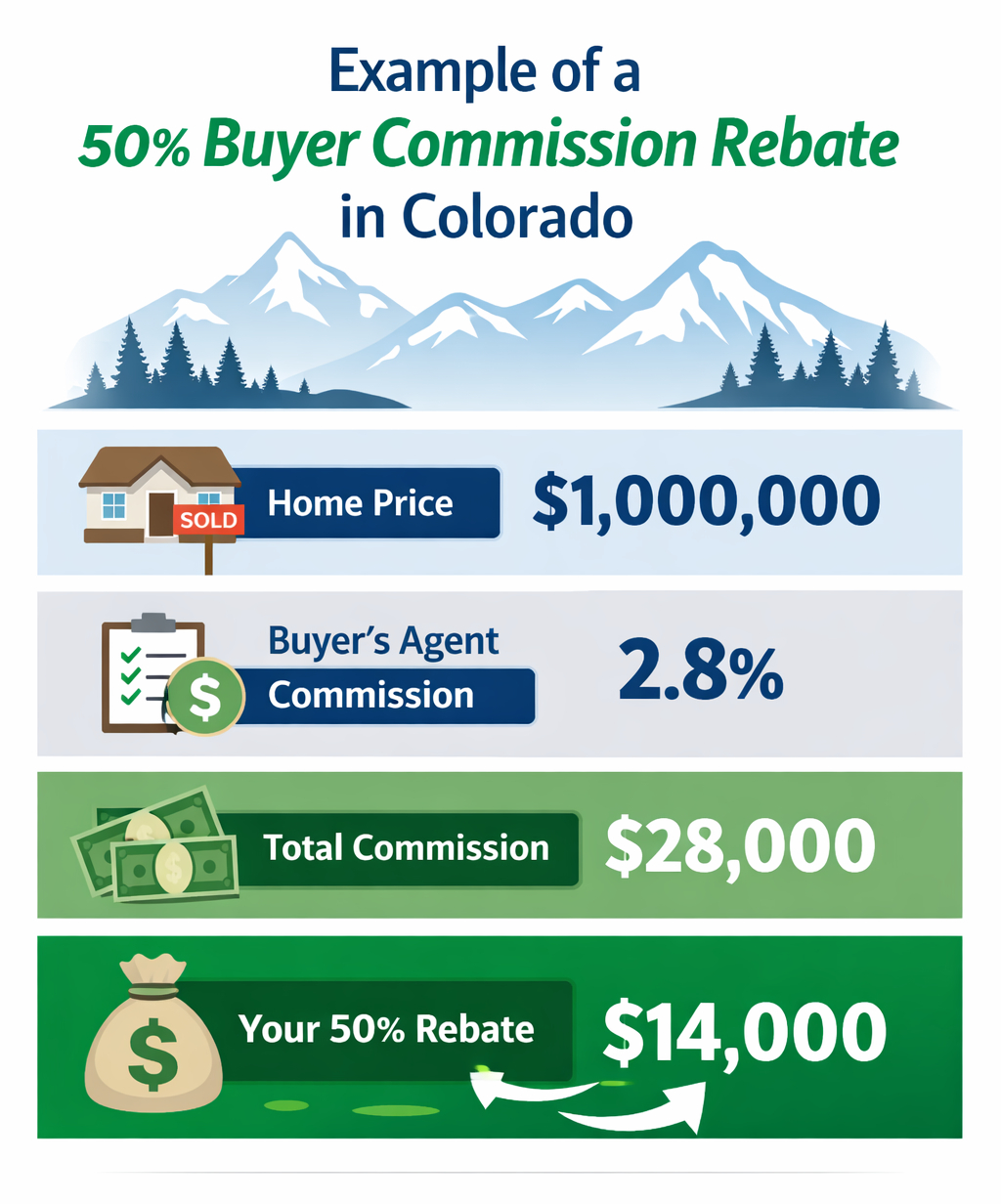
Quick Answer: Buyer commission rebates in Colorado are legal and allow homebuyers to receive a portion of the buyer agent’s commission at closing. At EZ Agents, we split the buyer agent commission 50/50 with our clients. This guide explains how rebates work, what Colorado rules require, how much you can save, and what changed after the NAR settlement.
This page covers the legal framework, real-world savings examples, and how rebates apply to both financed and cash buyers in today’s Colorado real estate market.
If you’re planning to buy, you can also learn what it’s like to work with a Denver buyers agent and how our process works from showings through closing.
Many buyers have additional questions about how commission rebates work, including legality, taxes, and how they apply to closing costs. See our guide:
Top Questions About Buyer Commission Rebates in Colorado.
What Is a Buyer Commission Rebate?
A buyer commission rebate is when a real estate agent gives a portion of their earned commission back to the homebuyer at closing. The rebate is disclosed on the settlement statement and, when financing is involved, must be approved by the buyer’s lender.
In most transactions, the seller offers compensation to the buyer’s agent as part of the purchase agreement. When working with a Denver rebate realtor, instead of retaining the full commission, the agent shares a portion of that compensation with the buyer.
Learn more about how our 50% buyer commission rebate works in Colorado and, if you’re wondering how that compares to the traditional model, see how a rebate Realtor compares to a traditional Realtor in Denver
.
How Rebates Work for Financed Buyers
If you are using a mortgage, the rebate typically appears as a credit on the Closing Disclosure and may be applied toward allowable closing costs or certain prepaid items, subject to lender guidelines.
Lender approval is required because credits cannot exceed permitted limits under the specific loan program.
How Rebates Work for Cash Buyers
If you are purchasing the property with all cash, the process is generally simpler. Because there is no lender involved, there are no loan program restrictions.
In a cash transaction, the rebate is disclosed on the settlement statement and appears as a credit that directly reduces your cash to close by that amount.
Example:
- If the buyer agent commission is $28,000 and the rebate is $14,000, the settlement statement would reflect a $14,000 credit, reducing the total amount of funds required to close.
The key requirement—whether financed or cash—is full disclosure on the settlement statement or Closing Discolure.

Homebuyers signing final documents at closing in Colorado, where buyer commission rebates are applied as closing credits.
Are Buyer Commission Rebates Legal in Colorado?
Yes. Buyer commission rebates are legal in Colorado as long as they are properly disclosed and comply with applicable regulations and lender guidelines.
The rebate must:
- Be disclosed on the Closing Disclosure (CD) or settlement statement
- Be approved by the buyer’s lender (if financing is involved)
- Be structured as a documented commission credit—not an off-the-books payment
Colorado allows licensed brokers to share earned commissions with their clients. The key requirement is transparency and proper documentation.
What Rebates Cannot Be
A compliant rebate is not:
- An undisclosed payment made after closing
- Cash handed to a buyer outside of settlement
- An off-record “side agreement”
Rebates must be reflected in the transaction documents. Attempting to structure compensation outside the closing process can create legal, contractual, and lending issues. For this reason, properly structured commission credits are the standard approach in compliant rebate transactions.
For a detailed breakdown of rebate legality, disclosure requirements, and lender considerations, see our guide on whether buyer commission rebates are legal in Colorado.
How Does a 50% Realtor Rebate Work? (With Real Numbers)
If you want a detailed breakdown of how commissions are negotiated and how the 50% structure works step by step, read our full explanation of how a 50% buyer commission rebate actually works.
Let’s walk through a simple example.
Example: $800,000 Home
- Buyer agent commission negotiated: 2.8%
- Total commission earned: $22,400
- 50% rebate to buyer: $11,200
That $11,200 is credited toward allowable closing costs and/or approved prepaid items based on lender guidelines (if financing is involved).
Example: $1,000,000 Home (2.8%)
-
- Total commission: $28,000
- Buyer rebate: $14,000
Most buyers apply their rebate directly toward closing costs such as lender fees, title insurance, escrow charges, and prepaid taxes. Some buyers also choose to use the credit for a mortgage rate buydown, which can lower the interest rate and reduce the monthly payment. If you’re unfamiliar with how these credits are applied during a real estate transaction, see our guide explaining how closing credits work when buying a home.
You can estimate your rebate using our commission savings calculator.
What Changed After the NAR Settlement?
The National Association of Realtors (NAR) settlement introduced changes to how commissions are communicated and negotiated. Key updates include:
- Buyer agent compensation is more explicitly negotiated
- Buyer representation agreements now clearly define buyer-agent compensation in advance
- Commission transparency has increased
What did not change:
- Commissions remain negotiable
- Rebates remain legal in Colorado (with proper disclosure)
- Sellers can still offer buyer agent compensation
How Much Can You Save in Denver or Boulder?
In higher price ranges, the savings can be significant. Here are simple examples using a 2.8% buyer agent commission and a 50% rebate.
| Home Price | Buyer Agent Commission (2.8%) | 50% Rebate to Buyer |
|---|---|---|
| $900,000 (Denver Example) | $25,200 | $12,600 |
| $1,000,000 | $28,000 | $14,000 |
| $2,500,000 (Boulder Example) | $70,000 | $35,000 |
Many buyers use their rebate to:
- Buy down their mortgage rate (points) — potentially lower monthly payment (subject to lender rules)
- Offset allowable closing costs — reduce cash needed at closing
- Prepay HOA dues — where permitted (HOA and lender approval may be required)
- Prepay PMI — in some scenarios, depending on loan structure and down payment (lender approval required)
- Increase renovation budget — invest directly into the home
- Strengthen financial reserves — maintain liquidity after closing

A mortgage professional reviewing loan options with buyers and explaining how commission credits may be applied toward allowable closing costs, discount points, or prepaid items (subject to lender guidelines).
Are Realtor Commissions Negotiable in Colorado?
Yes. Realtor commissions are fully negotiable in Colorado. There is no fixed or mandated commission rate.
Commissions are determined through agreement between the parties involved and can vary based on brokerage structure, services provided, and market conditions.
How Commissions Work in Today’s Market
In Colorado’s current environment, buyer agent compensation is typically addressed in two places:
- The Buyer Representation Agreement — this agreement outlines the compensation your agent expects to receive for representing you.
- The Purchase Contract — the offer submitted to the seller may request that the seller pay some or all of the buyer agent’s compensation as part of the transaction.
This means commission is not only negotiated with your agent—it may also be negotiated as part of the purchase offer itself.
What Happens If the Seller Does Not Pay?
In some cases, a seller may:
- Decline to offer buyer agent compensation
- Offer less than what is outlined in your representation agreement
If that occurs, and your agreement obligates you to a certain compensation amount, you may be responsible for covering the difference unless it is renegotiated.
For this reason, it’s important that buyers clearly understand:
- What compensation amount is written into their representation agreement
- How that compensation will be requested in the offer
- Whether any shortfall would be the buyer’s responsibility
- Whether a rebate structure applies
Why Transparency Matters
Buyers should feel comfortable asking:
- What commission is being requested?
- Who is expected to pay it?
- What happens if the seller does not agree?
- How does a commission rebate factor into the agreement?
Understanding these elements upfront prevents surprises and allows buyers to make informed financial decisions.
Are There Downsides to Using a Rebate Realtor?
Some agents argue that rebate models reduce service levels. In reality, service quality depends on the brokerage structure—not whether a rebate is offered.
The assumption is that if an agent shares commission, they must be earning less. However, many traditional agents already net far less than 50% of the commission due to legacy brokerage structures and layered overhead.
A traditional commission breakdown often includes:
- Brokerage splits
- Team leader splits
- Administrative and franchise fees
- Lead generation costs (sometimes 30–40% to third-party platforms such as Zillow)
- Office overhead and marketing expenses
After these deductions, many agents retain well under half of the gross commission.
At EZ Agents, we operate with a streamlined, tech-enabled model designed to reduce unnecessary hierarchy and overhead. By minimizing those structural costs, we are able to deliver full-service representation while sharing 50% of the buyer agent commission with our clients.
In other words, the rebate doesn’t come from cutting service—it comes from eliminating inefficiency.
Using Your Rebate Strategically
Smart buyers often use their rebate to reduce out-of-pocket costs or improve loan terms at closing. In many cases, the rebate is applied as a credit on the settlement statement and can be used for allowable transaction expenses. For a detailed breakdown, see how to use a buyer commission rebate in Colorado.
Common ways buyers use their rebate include:
- Buying down mortgage points to potentially reduce the interest rate (subject to lender rules)
- Prepaying HOA dues where permitted (HOA and lender approval may be required)
- Prepaying PMI in some scenarios, depending on loan structure and down payment (lender approval required)
- Offsetting allowable closing costs to reduce cash needed at closing
Frequently Asked Questions About Buyer Commission Rebates
Are commission rebates taxable?
Can lenders restrict rebates?
Are rebates available on new construction?
Does the seller pay the rebate?
Can any Realtor offer a rebate?
Do buyers have to pay realtor commission in Colorado now?
What can I use the rebate for?
Buyer commission rebates are typically applied toward closing costs, prepaid items, or other allowable transaction expenses. For a full breakdown, see how to use a buyer commission rebate in Colorado.
Not sure how much of the rebate you can actually use at closing? Read our detailed example of how a buyer commission rebate is applied in Colorado.
Why Work With EZ Agents?
EZ Agents was built around how modern buyers actually shop for homes.
Today’s buyers search online, compare properties digitally, monitor market alerts, and often identify homes before speaking with an agent. Our model recognizes this shift and streamlines the process around what buyers need most: speed, clarity, negotiation expertise, and financial efficiency.
Instead of operating under a traditional commission structure built decades ago, we focus on:
- Full-service representation — offer strategy, negotiation, inspections, contract management, and closing guidance
- Transparent commission structure — clear disclosure of how compensation works
- 50% commission rebate — sharing the buyer agent commission with you
- High-volume, tech-enabled efficiency — leveraging systems and modern tools to reduce overhead while maintaining service quality
By reducing unnecessary brokerage layers and outdated cost structures, we are able to deliver full-service representation while returning a significant portion of the commission to our clients.
The result is a model aligned with how buyers shop today—without sacrificing professional advocacy or compliance.
Read client reviews here: Testimonials
See How Much You Could Save
If you’re buying a home in Denver, Boulder, or anywhere in Colorado, you may qualify for a significant commission rebate.
Start here: Calculate Your Savings
Or learn more about us: About EZ Agents