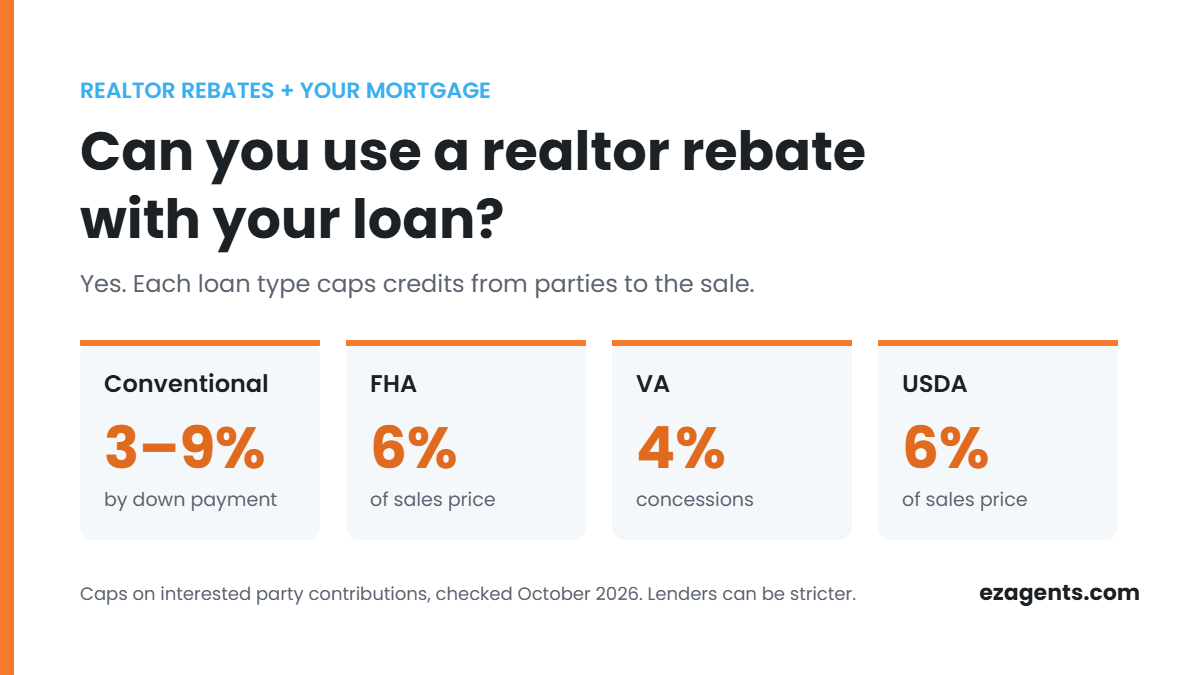
Short answer: Yes. You can use a realtor rebate with a conventional, FHA, VA or USDA loan, as long as your lender approves it and the rebate shows up as a credit on your settlement statement at closing. Each loan type caps how much buyers can receive in credits from parties to the sale, and the rebate counts toward that cap.
A realtor rebate is when your buyer’s agent gives part of their commission back to you at closing. In most cases it lowers what you owe at the table, much like a seller concession. The catch is that your lender has rules about credits, and those rules depend on the type of loan you have. Here is how it works for each one.
Why your lender cares about a rebate
Lenders treat your real estate agent as an “interested party,” meaning someone who benefits from the sale closing. Money an interested party puts toward your purchase is called an interested party contribution. Seller credits fall in this group, and so does a rebate from your agent.
Lenders limit these contributions for one reason: they don’t want credits quietly inflating the price of the home. So a rebate has to be disclosed to your lender, approved by them, and listed on your settlement statement. Fannie Mae’s guidelines are explicit that an agent rebate not credited in the transaction counts as a sales concession, which gets subtracted from the sales price when the lender figures your loan. That is why a rebate should always be a credit at closing, never a check paid outside of it. For more on how credits show up on your paperwork, see how closing credits work.
How much rebate each loan type allows
These limits apply to all interested party contributions combined. If the seller is also giving you a credit, the seller credit and your rebate share the same cap.
| Loan type | Cap on credits from interested parties | Based on |
|---|---|---|
| Conventional, less than 10% down | 3% | Lower of price or appraised value |
| Conventional, 10% to just under 25% down | 6% | Lower of price or appraised value |
| Conventional, 25% or more down | 9% | Lower of price or appraised value |
| Conventional, investment property | 2% | Lower of price or appraised value |
| FHA | 6% | Sales price |
| VA | 4% for concessions; standard closing costs are not capped | The home’s reasonable value |
| USDA | 6% | Sales price |
Conventional limits are from Fannie Mae’s Selling Guide (B3-4.1-02); Freddie Mac’s are similar. FHA, VA and USDA limits are from each program’s guidelines. Individual lenders can set stricter rules than the program does.
What a rebate can and can’t pay for
A rebate can generally go toward:
- Lender fees, appraisal, title and other closing costs
- Prepaid items like property taxes, homeowners insurance and prepaid interest
- Discount points to buy down your interest rate, when your loan program allows it
A rebate generally can’t:
- Count toward your down payment
- Be handed to you as cash back at closing
- Exceed your actual closing costs and prepaids
What if your rebate is bigger than your closing costs?
This is the most common problem, and it usually shows up on more expensive homes, where the rebate is largest. If the rebate is more than your closing costs, the extra can’t come back to you as cash. You have a few ways to keep it from going to waste:
- Buy down your rate. Putting the extra toward discount points can lower your monthly payment for the life of the loan. We walk through the math in how to use a commission rebate to buy down your rate.
- Cover more prepaids. A larger escrow deposit for taxes and insurance is still a closing cost.
- Ask for less from the seller. If you were going to ask for a seller credit, your rebate may already cover those costs. Some buyers use that to make a stronger offer instead.
Two quick examples
Fits easily: A buyer purchases a $600,000 home with a conventional loan and 10% down. The cap is 6%, or $36,000. If the buyer agent commission is 2.8%, a 50% rebate is $8,400. As long as closing costs and prepaids are at least $8,400 and any seller credit doesn’t push the total past $36,000, the full rebate applies.
Runs into the cap: A buyer purchases a $500,000 home with 5% down. The cap drops to 3%, or $15,000. The seller agrees to a $10,000 credit, and the rebate is $6,500. Together that is $16,500, which is $1,500 over the cap. The fix is usually simple: ask the seller for $8,500 instead of $10,000, and the buyer gets the same total help at closing.
These examples assume a 2.8% buyer agent commission for illustration only. Commissions are not set by law, are fully negotiable and vary from home to home, and your lender sets your actual closing costs. Your rebate is based on the commission actually paid on your purchase.
Your state’s rules are a separate question
Loan rules decide how much of a rebate your lender will accept. State law decides whether an agent can offer a rebate at all. Most states allow it, a handful ban or restrict it, and some require specific disclosures. Our guide to buyer commission rebates by state covers where they are legal.
How to make sure your rebate goes through
- Get it in writing. The rebate should be spelled out in your agreement with your agent before you start touring.
- Tell your lender early. Mention the rebate when you apply, not the week of closing. Your loan officer can confirm the cap for your loan and flag any lender-specific rules.
- Check your Closing Disclosure. The rebate should appear as a credit from your agent. If it isn’t there, raise it before you sign.
- Plan around the cap. If you are putting less than 10% down or negotiating a big seller credit, run the numbers together so nothing goes over the limit.
Buying in Colorado? EZ Agents gives you 50% of the buyer agent commission back as a credit at closing, with full-service representation from contract to closing. See how much you could get back.
Buying in another state? Reach out and tell us where you’re moving. We may be able to point you toward an agent there who offers a rebate.
Frequently asked questions
Does a realtor rebate count as a seller concession?
Not exactly, but lenders treat it much the same way. Your agent is an interested party, so the rebate counts toward the same cap on credits as any seller concession.
Can I use a realtor rebate for my down payment?
Generally no. Conventional, FHA, VA and USDA loans all limit interested party credits to closing costs and prepaid items, not the down payment.
Can I use a rebate with an FHA loan?
Yes. FHA allows credits from interested parties, including your real estate agent, of up to 6% of the sales price toward closing costs and prepaids, as long as the credit is disclosed and approved by your lender.
What happens if my rebate is more than my closing costs?
The extra can’t be paid to you as cash. Most buyers put it toward discount points to lower their rate, a larger escrow deposit, or ask the seller for a smaller credit.
This article is general information, not legal, tax or lending advice. Loan program rules and state real estate laws change, and individual lenders can be stricter than the programs they follow. Rules were checked against Fannie Mae, FHA, VA and USDA guidance in October 2026. Confirm the details for your purchase with your lender and your state’s real estate commission.