You read about buyer commission rebates, ran the numbers, and liked the idea of getting part of the commission back at closing. Then you saw a list saying your state bans them. Check whether that list is current, and what you can still do if the ban is real.
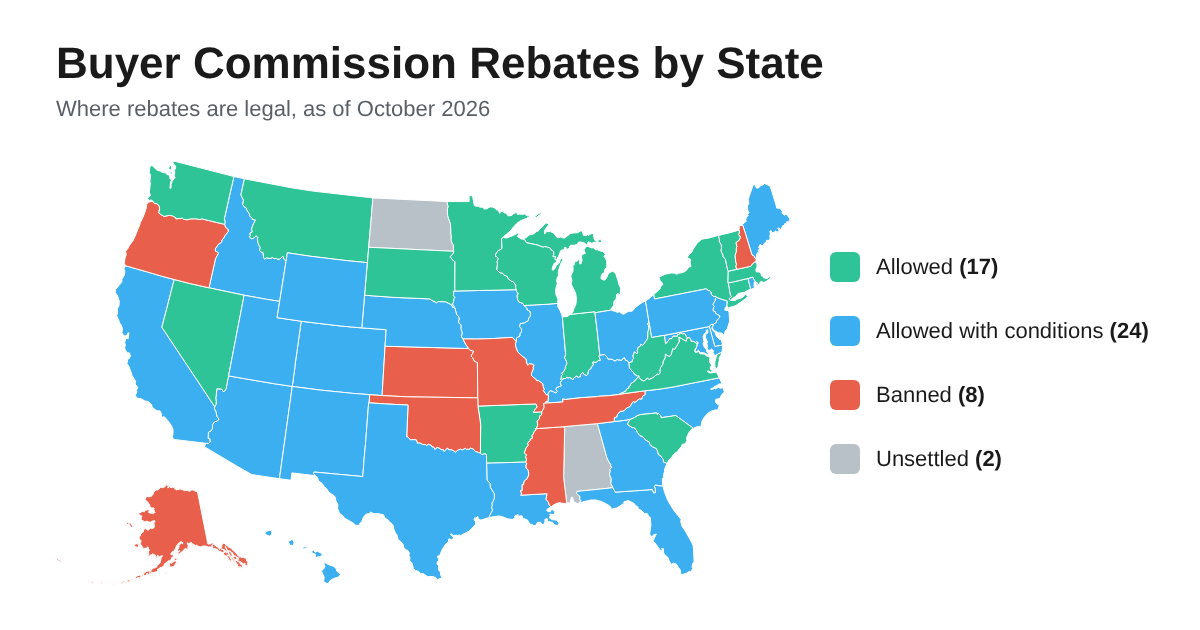
Based on our state-by-state research, 8 states ban buyer commission rebates: Alaska, Kansas, Mississippi, Missouri, New Hampshire, Oklahoma, Oregon and Tennessee. Alabama and North Dakota are unsettled. Every other state, plus DC, allows rebates, most with conditions such as written disclosure. In a ban state, you can still negotiate a lower buyer’s agent fee up front and ask the seller for concessions where your loan allows.
The 8 states that ban buyer rebates
In these states, the law stops an agent from giving part of their commission back to the buyer. Here is the short version of each rule. Our buyer commission rebate guide by state has the full table with the law cited for every state.
- Alaska. Sharing commission with an unlicensed person, including your own client, is prohibited.
- Kansas. The statute bars any rebate, disclosed or not. A 2020 repeal effort did not pass.
- Mississippi. The statute bars paying any rebate to a non-licensee.
- Missouri. The statute bars money or gifts conditioned on a purchase, with no exception for disclosed rebates.
- New Hampshire. The statute bars giving more than $100 in value to an unlicensed person, clients included.
- Oklahoma. The statute bars sharing commission with unlicensed persons and offering purchase inducements.
- Oregon. The statute bars rebates to anyone unlicensed. A 2020 lawsuit did not change it.
- Tennessee. The statute bars cash rebates. Non-cash gifts are allowed only under strict rules.
The 2 states that are unsettled
- Alabama. The law bans “rebates,” but the real estate commission allows disclosed buyer incentives at closing. Confirm with the Alabama Real Estate Commission.
- North Dakota. The statute bars paying unlicensed persons and gives no guidance on buyer rebates. Confirm with the state commission.
In either state, ask the agents you interview how they handle it.
What “banned” actually means
A rebate ban is narrow. It means an agent cannot give part of the commission they earn back to the buyer, whether as a closing credit, a check or, in some states, a gift above a small value.
It does not mean buyers in those states must pay a set fee. Commissions are negotiable everywhere, by law, in every state. A ban on rebates is not a ban on paying less.
Why older lists online are wrong
Many rebate lists were written years ago and copied from site to site. State laws have changed since, and some lists were wrong to begin with. Three states show up wrong most often.
- Kansas is still a ban state. Some sites say Kansas repealed its ban in 2020. The repeal bill did not pass, and the statute still bars rebates.
- Iowa now allows rebates. Older lists show Iowa as a ban state. A 2024 rule change allows rebates to the broker’s own buyer client, with disclosure.
- Louisiana allows disclosed rebates. Louisiana’s statute bars only undisclosed rebates. When the rebate is disclosed in writing to all parties, it is allowed.
Are rebates legal in Texas, Florida or my state?
Most likely, yes. Of the 50 states and DC, 41 allow buyer rebates. Texas, for example, allows rebates to the agent’s own client, and advertising must carry the required disclosure language. Florida, California, Colorado and many others allow them with conditions.
The common conditions are simple: the rebate is disclosed in writing, it shows up on the closing or settlement statement, and your lender knows about it and approves it. Find your state in the rebate laws by state table to see its status and the law behind it.
What to do instead in a ban state
If your state bans rebates, you still have real ways to keep more money in your pocket.
1. Negotiate a lower buyer’s agent fee up front
This is usually the best route. Instead of the agent earning a full fee and giving part back, you agree on a smaller fee from the start. Nothing is rebated, so the ban does not apply.
Ask every agent you interview the same questions:
- What do you charge, and is that number negotiable?
- Do you offer a reduced or flat fee, or a fee that changes with price?
- What does our state allow, and what does your broker allow?
- If the seller offers to pay my agent, how will a lower fee actually reach me?
That last question matters. If you pay your agent yourself, a lower fee is a direct saving. If the seller is paying your agent, the saving may show up as a lower price or more room for seller concessions in your offer, rather than as cash to you. A good agent can explain how they would structure it in your state.
| Item | Amount |
|---|---|
| Fee at 2.8% | $14,000 |
| Negotiated fee at 1.5% | $7,500 |
| Lower cost to you | $6,500 |
Illustration only. Commissions are negotiable and vary.
For a deeper comparison of the two approaches, see rebate vs. a lower buyer’s agent fee.
2. Ask the seller for concessions
Seller concessions come from the seller, not your agent, so a rebate ban does not touch them. You can ask the seller to cover part of your closing costs, prepaid items or a rate buydown as part of your offer.
Your loan limits how much the seller can contribute. Typical caps on credits from interested parties are:
- Conventional: 3% with under 10% down, 6% with 10% to 25% down, 9% with 25% or more down.
- FHA: 6%.
- VA: 4%.
Your lender has the final word on what counts and how much is allowed. Credits generally go to closing costs, prepaids and buydowns, not your down payment. Learn more in how closing credits work.
How rebates work where they are allowed
In Colorado, where rebates are allowed with disclosure, EZ Agents returns 50% of the buyer’s agent commission as a “Credit From Agent” line on the settlement statement at closing. A $7,500 minimum commission applies on our side. Steve Novak, founder of EZ Agents, is a top 1% Colorado Realtor and the #6 agent in Denver (RealTrends), with $200M+ in closed transactions and $1.5M+ in rebates paid to buyers. See how a buyer commission rebate works.
Buying outside Colorado?
EZ Agents is licensed in Colorado only. Looking for a rebate agent in your state? Reach out and we will see if we can help point you in the right direction. You can also start with the state-by-state rebate guide.
State real estate laws and commission rules change, and they are interpreted differently by different regulators. This article is general information, not legal or tax advice, and it may already be out of date. EZ Agents is licensed in Colorado only. Before relying on a rebate in any other state, confirm the current rules with a licensed agent in that state or that state’s real estate commission. Last reviewed November 2026.
Frequently asked questions
Which states ban buyer commission rebates?
Based on our research, 8 states ban them: Alaska, Kansas, Mississippi, Missouri, New Hampshire, Oklahoma, Oregon and Tennessee. Alabama and North Dakota are unsettled. The other states and DC allow rebates, most with conditions such as written disclosure.
Are real estate rebates legal in Texas?
Yes. Texas allows an agent to give a rebate to their own client, and the agent’s advertising must carry the required disclosure language. Confirm the current rules with a Texas agent or the Texas Real Estate Commission.
Did Kansas legalize real estate rebates?
No. Some sites say Kansas repealed its ban in 2020, but the repeal bill did not pass. The Kansas statute still bars rebates, disclosed or not.
Can I still save on commission in a state that bans rebates?
Often, yes. Commissions are negotiable in every state, so you can negotiate a lower buyer’s agent fee up front instead of a rebate. You can also ask the seller for concessions toward closing costs, within your loan’s limits.
Are rebates allowed in Iowa and Louisiana?
Yes, with conditions. Iowa has allowed rebates to the broker’s own buyer client since a 2024 rule change, with disclosure. Louisiana bars only undisclosed rebates, so a rebate disclosed in writing to all parties is allowed.
Want to keep more of the commission?
Buying in Colorado, call Steve to see what your credit at closing could be; buying elsewhere, reach out and we will see if we can point you toward a rebate agent.