There are two common ways to pay less for a buyer’s agent. Your agent can give part of their commission back to you as a credit at closing, which is a rebate. Or you can agree to a lower fee from the start. Depending on who pays your agent and how you finance, they can work out very differently.
If the seller is paying your agent, a rebate usually saves you more, because a lower fee may only save the seller money. If you are paying your agent yourself, a lower fee and a rebate often work out about the same. Lender limits on closing credits can reduce what a financed buyer can use from a rebate, and in states that ban rebates, negotiating a lower fee is the available path.
Two ways to pay less
Both options start from the same place. A buyer’s agent earns a commission when you close. What changes is where the savings land.
- A rebate. Your agent is paid their full commission, then gives part of it back to you. It usually shows up as a credit on your closing or settlement statement, reducing what you owe at the table. Learn more in how a buyer commission rebate works.
- A lower fee. You and your agent agree on a smaller commission up front. Less is paid to your agent at closing, and no credit is involved.
Commissions are negotiable everywhere, by law, in every state. No rate is fixed, standard or required. That means a lower fee is always something you can ask for. Whether a rebate is allowed depends on your state, which we track in our buyer commission rebate guide by state.
The key question: who is paying your agent?
Your agent’s commission can be paid by the seller, by you, or by a mix of both. Sometimes the seller offers less than your agent’s fee, or nothing at all, and you cover the rest. We explain that situation in what happens when a seller offers less buyer’s agent commission.
Who writes the check matters, because a lower fee only saves money for whoever was going to pay it.
When the seller pays your agent
Say the seller has agreed to pay your agent’s commission. If your agent then agrees to a lower fee, the seller simply pays less. That savings stays with the seller unless you manage to negotiate it into a lower price, which is a separate negotiation with no guarantee.
A rebate works differently. The seller pays your agent the agreed commission, and your agent credits part of it back to you at closing. The money comes out of your agent’s pay and goes to you.
| Outcome | Amount |
|---|---|
| Lower fee (1.5%): seller pays your agent | $9,000 |
| Lower fee: your savings (unless negotiated into price) | $0 |
| Rebate: seller pays your agent (2.8%) | $16,800 |
| Rebate: your credit at closing | $7,800 |
Illustration only. Commissions are negotiable and vary.
When you pay your agent yourself
Now say the seller is not covering your agent’s commission and you are paying it at closing. Here a lower fee and a rebate can land in a similar place. Either way, you end up paying your agent less.
| Outcome | Amount |
|---|---|
| Lower fee (1.5%): you pay your agent | $9,000 |
| Rebate: you owe your agent (2.8%) | $16,800 |
| Rebate: credit back to you at closing | -$7,800 |
| Rebate: your net cost | $9,000 |
Illustration only. Commissions are negotiable and vary.
The math matches, but the mechanics are not identical. A lower fee is simpler. There is no credit for your lender to review and nothing extra to show on the closing statement.
Lender limits can cap a rebate
If you are using a mortgage, your lender decides how much credit it will allow at closing. Many loan programs cap credits from parties to the transaction, and the caps often vary by loan type and down payment. Credits also generally have to go toward closing costs, prepaid items or a rate buydown, not your down payment.
That can matter in a few ways.
- A small closing-cost bill. If your allowable costs are lower than the rebate, you may not be able to use all of it as a credit.
- Stacked credits. If the seller is also giving you a credit, the combined total may run into the cap.
- Lender approval. The rebate has to be disclosed to your lender, and some lenders have their own rules on top of program limits.
A lower fee does not run into these limits, because there is no credit involved. Cash buyers have no lender step at all. For more detail, see using a buyer rebate with a mortgage and rebates with FHA, VA and conventional loans.
In states that ban rebates
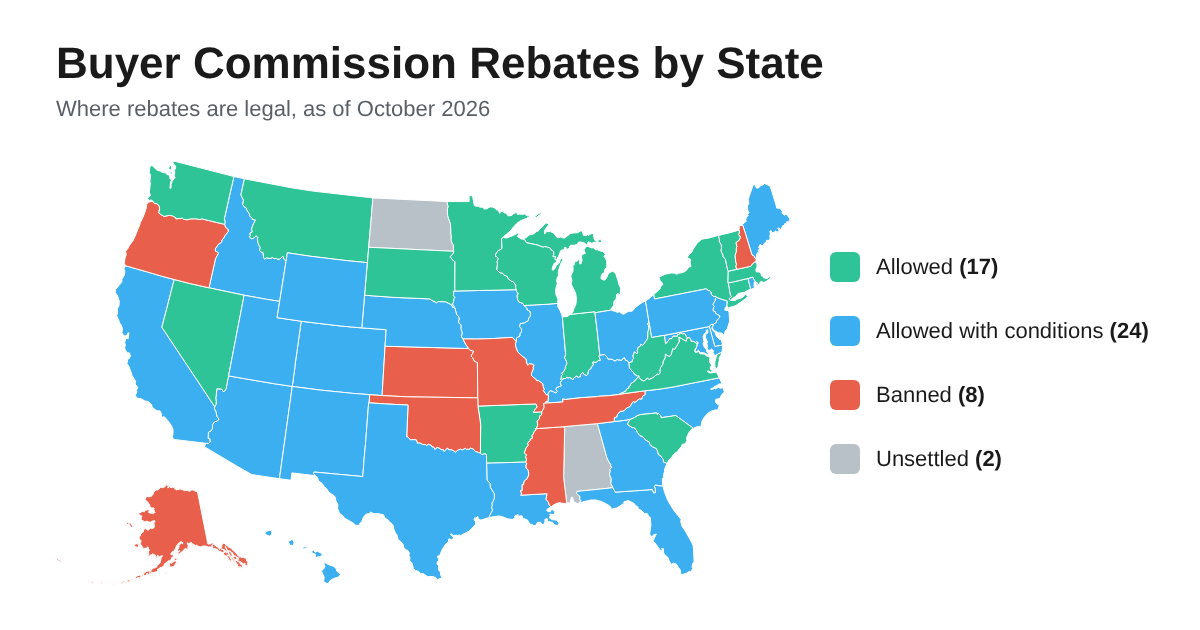
A handful of states do not allow agents to rebate part of their commission to buyers. Our guide currently lists Alaska, Kansas, Mississippi, Missouri, New Hampshire, Oklahoma, Oregon and Tennessee, with Alabama and North Dakota unsettled. In those states, a lower fee is the path that is available.
Because commissions are negotiable everywhere, you can still ask an agent for a reduced fee before you start. If the seller is covering your agent’s commission, you can also weigh whether to factor that into your offer price. See states that ban buyer commission rebates for more.
Compare the service, too
Some agents who cut their fee or offer a rebate also cut services to make the numbers work. Ask what is included, from negotiating price and inspection items to handling the appraisal. We compare the models in rebate Realtor vs. discount Realtor.
How EZ Agents does it in Colorado
EZ Agents is a full-service real estate company in Colorado, where rebates are allowed with conditions. For buyers, 50% of the buyer’s agent commission comes back as a “Credit From Agent” line on your settlement statement at closing. It is a credit off what you owe, not a check. A $7,500 minimum commission applies on our side.
Steve Novak, founder of EZ Agents, is a top 1% Colorado Realtor and the #6 agent in Denver (RealTrends), with $200M+ in closed transactions and $1.5M+ in rebates paid to buyers.
Buying outside Colorado?
EZ Agents is licensed in Colorado only. Looking for a rebate agent in your state? Reach out and we will see if we can help point you in the right direction. In the meantime, interview agents where you are buying and ask them directly about rebates and fees. Our state-by-state rebate guide is a good place to start.
State real estate laws and commission rules change, and they are interpreted differently by different regulators. This article is general information, not legal or tax advice, and it may already be out of date. EZ Agents is licensed in Colorado only. Before relying on a rebate in any other state, confirm the current rules with a licensed agent in that state or that state’s real estate commission. Last reviewed November 2026.
Frequently asked questions
Is a rebate better than a lower buyer’s agent fee?
It depends on who pays your agent. If the seller is paying, a rebate usually saves you more, because a lower fee may only reduce what the seller pays. If you are paying your agent yourself, the two often work out about the same.
If my agent lowers their fee, do I save money?
Only if you were the one paying the fee. If the seller agreed to pay your agent, a lower fee means the seller pays less, and you only benefit if you negotiate that savings into your price.
Can my lender limit a commission rebate?
Yes. Your lender decides how much credit it will allow at closing, and many loan programs cap credits from parties to the transaction. Credits generally go toward closing costs, prepaid items or a rate buydown, not your down payment. A lower fee does not run into these limits.
What can I do if my state bans rebates?
You can negotiate a lower fee. Commissions are negotiable everywhere, by law, in every state, so you can ask an agent for a reduced fee before you start, even where rebates are not allowed.
Is a commission rebate taxable?
The IRS has generally treated a buyer’s rebate as a reduction in purchase price, which lowers your cost basis, rather than as income. Rules can depend on your situation, so confirm with a tax professional.
See what you could keep
Colorado buyers can call Steve to see what their credit at closing could be, and buyers outside Colorado can reach out about a referral.