Search for ways to save on a buyer’s agent and you will run into a handful of labels: rebate realtor, discount realtor, flat-fee agent, cash-back agent. They sound like different things. In practice they overlap a lot, and the label matters less than how the agent actually works and how the savings reach you.
A rebate realtor gives part of their commission back to you, usually as a credit at closing. A discount realtor charges a lower fee to begin with. A flat-fee agent charges a set dollar amount, and a cash-back agent is usually just another name for a rebate agent. The terms are often used interchangeably. What matters is whether the service is full or limited, who does the work, how the savings are delivered, whether there is a minimum, and whether rebates are allowed in your state.
Rebate realtor vs. discount realtor: the basic definitions
Here is how each term is usually used. Individual agents may use them differently, so always ask.
Common terms buyers search for
- Rebate realtor. The agent earns a commission and gives part of it back to you, often as a credit on your closing statement.
- Discount realtor. The agent charges a lower fee or percentage than you might otherwise pay, so less is owed in the first place.
- Flat-fee agent. The agent charges a set dollar amount instead of a percentage. Any compensation above that amount may be credited back to you.
- Cash-back agent. A marketing term that usually means a rebate. The “cash” typically arrives as a closing credit, not a check.
A rebate is not a discount on the home or a separate payment from the seller. It comes out of the agent’s own commission. You can read more about how that works in our buyer commission rebate overview.
Why the terms overlap
All four labels describe the same goal: you keep more of the money that would otherwise go to your agent. The difference is mostly in the mechanics.
- A rebate agent and a discount realtor can end up with a similar net cost to you. One reduces the fee up front, the other credits part of it back at closing.
- A flat-fee agent can work like a rebate. If the seller or builder offers more than the flat fee, the extra may come back to you as a credit.
- Many agents use more than one label in their marketing.
So do not choose an agent by the label alone. We compare two of these approaches side by side in rebate vs. a lower buyer’s agent fee.
Key differences to ask any discount realtor or rebate agent about
Full service or limited service?
This is the biggest one. Some discount and rebate agents offer full service, from search and tours through negotiation, inspections and closing. Others cut services to make their pricing work, such as fewer showings or no help at inspection. Know which one you are getting.
Who handles showings, negotiations and inspections?
Ask who will actually do the work. Find out who tours with you, who writes and negotiates your offer, and who handles the inspection response.
How are the savings delivered?
- Closing credit. The most common rebate method. It shows up on your settlement statement and reduces what you owe at the table. Learn more in how closing credits work.
- Lower fee. A discount realtor charges less, so the savings are built into the fee rather than credited back.
- Flat fee. You know the agent’s dollar amount up front, and any difference may be credited or may simply reduce what you owe.
If you are financing, your lender has to approve any credit. Loan programs cap credits from interested parties, and credits generally go toward closing costs, prepaid items or a rate buydown, not your down payment.
Is there a minimum?
Many rebate and discount agents set a minimum commission they keep. On lower-priced homes, that minimum comes out first, so the rebate may be smaller than the headline percentage. Ask what the minimum is and run the math on your price range.
Are rebates allowed in your state?
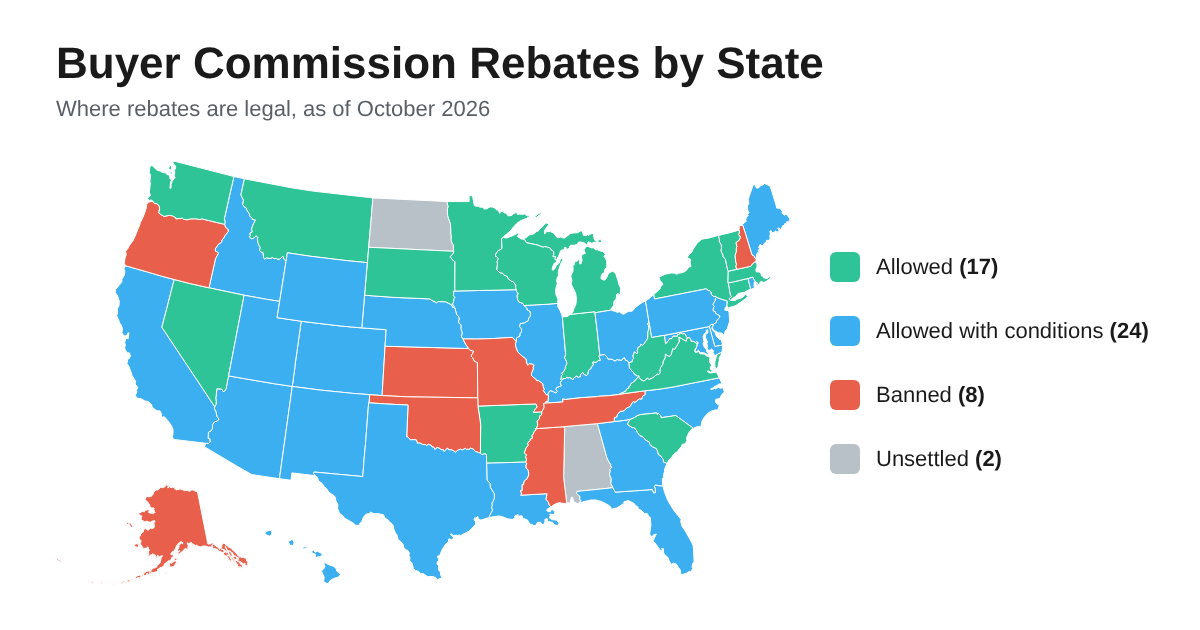
Most states allow buyer rebates, many with conditions like written disclosure and showing the credit on the closing statement. Eight states ban them: Alaska, Kansas, Mississippi, Missouri, New Hampshire, Oklahoma, Oregon and Tennessee. Alabama and North Dakota are unclear. See our state-by-state guide to buyer commission rebates and states that ban buyer commission rebates for details.
A rebate ban is not a ban on paying less. Commissions are negotiable everywhere, by law, in every state. Even where rebates are not allowed, a discount realtor who simply charges a lower fee may still be an option.
One example: how EZ Agents works in Colorado
EZ Agents is a full-service real estate company in Colorado, founded by Steve Novak. Half of the buyer’s agent commission comes back to the buyer as a “Credit From Agent” on the settlement statement at closing. A $7,500 minimum commission applies on our side.
| Item | Amount |
|---|---|
| Buyer’s agent commission (2.8%) | $19,600 |
| EZ Agents keeps (half, above the $7,500 minimum) | $9,800 |
| Your credit at closing | $9,800 |
Illustration only. Commissions are negotiable and vary. A $7,500 minimum commission applies. Credits are subject to lender approval.
Steve is a top 1% Colorado Realtor and the #6 agent in Denver (RealTrends), with $200M+ in closed transactions and $1.5M+ in rebates paid to buyers. Learn more on our Colorado rebate realtor page.
Questions to ask when you interview an agent
- Do you offer a rebate, a lower fee, or a flat fee?
- Is your service full or limited? What is not included?
- Who will show me homes, and who negotiates my offer and inspection items?
- How is the savings delivered: closing credit, lower fee or something else?
- Is there a minimum commission, and what would my savings look like at my price range?
- Are rebates allowed in this state, and what disclosures are required?
- Have you worked with my type of loan, and will my lender need to approve the credit?
Interview more than one agent in your state and ask about rebates or fees directly. Your state real estate commission is the official source on the rules.
State real estate laws and commission rules change, and they are interpreted differently by different regulators. This article is general information, not legal or tax advice, and it may already be out of date. EZ Agents is licensed in Colorado only. Before relying on a rebate in any other state, confirm the current rules with a licensed agent in that state or that state’s real estate commission. Last reviewed November 2026.
Buying outside Colorado?
Looking for a rebate agent or discount realtor in your state? Reach out and we will see if we can help point you in the right direction. You can also start with our guide to rebate rules by state.
Frequently asked questions
What is the difference between a rebate realtor and a discount realtor?
A rebate realtor earns a commission and gives part of it back to you, usually as a credit at closing. A discount realtor charges a lower fee to begin with. The net savings can be similar, and many agents use both labels, so ask how the savings are actually delivered.
Is a cash-back agent the same as a rebate agent?
Usually, yes. Cash-back is a marketing term for a rebate. In most cases the money arrives as a credit on your closing statement that reduces what you owe at closing, not as a check.
Do discount realtors offer less service?
Some do and some do not. Some discount and rebate agents offer full service, while others cut services to make their pricing work. Ask exactly what is included and who handles showings, negotiations and inspections.
Can I get a discount realtor in a state that bans rebates?
Often, yes. A rebate ban is not a ban on paying less. Commissions are negotiable everywhere, so in a ban state you may still be able to negotiate a lower fee with your agent. Confirm the rules with an agent in your state or the state real estate commission.
Can I use a rebate toward my down payment?
Generally, no. Lenders must approve credits, loan programs cap them, and they usually go toward closing costs, prepaid items or a rate buydown rather than the down payment. Ask your lender how your loan treats an agent credit.
Want to see what you could keep?
Colorado buyers can call Steve to see what their credit at closing could be, and buyers outside Colorado can reach out about a referral.