The 2024 NAR settlement changed how buyer’s agents get paid, and a lot of buyers are still unsure what that means at the closing table. Here is what changed, what did not, and where a commission rebate fits now.
Since August 17, 2024, offers of buyer’s agent compensation no longer appear in the MLS. What a buyer’s agent is paid is now negotiated, often as part of the purchase offer. A seller may pay some, all or none of it, and the buyer may owe any difference. Commissions were always negotiable and still are. Buyer commission rebates remain legal in most states, and when a seller pays the buyer’s agent, a rebate can return part of that money to the buyer as a credit at closing.
What the NAR settlement changed
The National Association of Realtors settled a series of class-action lawsuits over agent commissions in 2024. As part of that settlement, new practice rules took effect on August 17, 2024. Two changes matter most to buyers.
- No compensation offers in the MLS. Before the change, a listing in the MLS usually showed what the seller’s side would pay a buyer’s agent. That field is gone. Sellers can still offer to pay a buyer’s agent, but the offer is made outside the MLS.
- Written agreements before touring. The practice changes require buyers to sign a written agreement with their agent before touring homes.
Sellers can still offer buyer concessions in the MLS, such as help with closing costs.
Who pays the buyer’s agent now?
Buyer’s agent pay is now worked out deal by deal. It usually lands in one of three places.
- The seller pays all of it. Many sellers still agree to pay the buyer’s agent, either because they offered it up front or because the buyer asked for it in the offer.
- The seller pays part of it. A seller may agree to pay some amount, and the buyer covers the rest.
- The seller pays none of it. The buyer may owe the full amount to their own agent, or ask for other concessions in the offer to help offset it.
Often, the request shows up in the purchase offer itself. A buyer can ask the seller to pay the buyer’s agent, the same way they might ask for a closing cost credit or a repair.
If the seller agrees to pay less than the buyer’s agent is owed, the buyer may need to pay the difference. We walk through that scenario in what happens when a seller offers less buyer’s agent commission.
What did not change
Several important things stayed the same.
- Commissions are negotiable everywhere, by law, in every state. That was true before the settlement and it is true now. No rate is fixed, standard or required.
- Sellers can still pay buyer’s agents. The settlement did not ban seller-paid compensation. It moved the conversation out of the MLS.
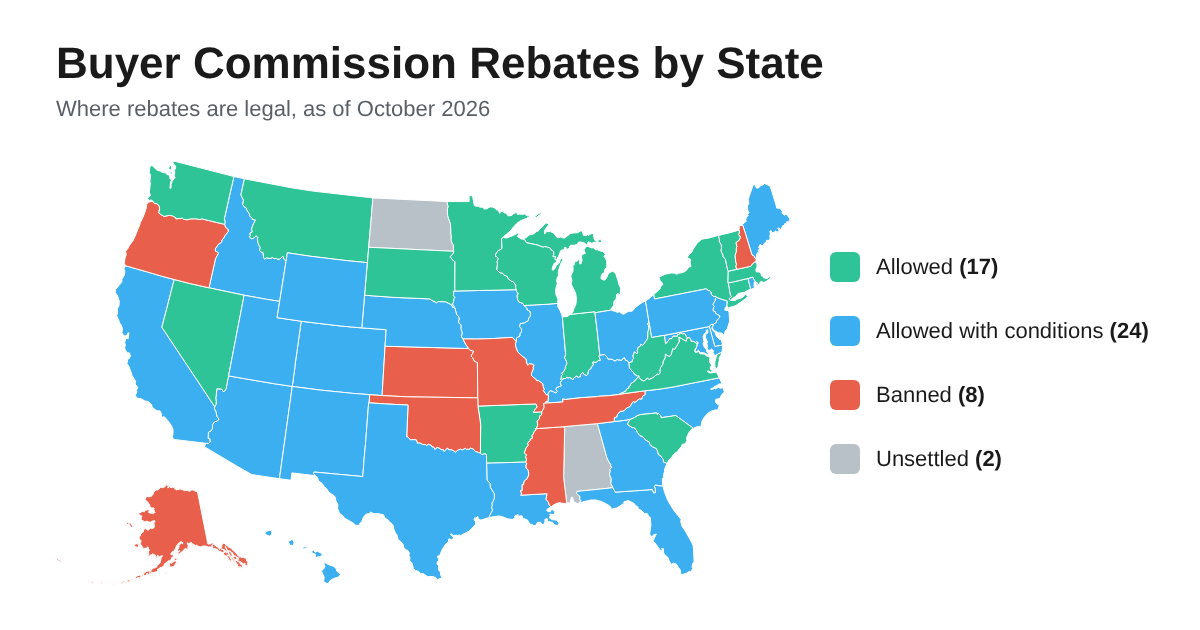
- Rebates are still legal where state law allows them. The settlement did not change state rebate laws. Most states allow a buyer’s agent to share part of their commission with the buyer, often with conditions like written disclosure and showing the credit on the closing statement. A small number of states ban buyer rebates. See our guide to buyer commission rebates by state for where they are allowed.
How a rebate fits after the settlement
A buyer commission rebate works the same way it did before. When the buyer’s agent is paid at closing, the agent gives part of that commission back to the buyer as a credit.
When the seller pays the buyer’s agent as part of the purchase, a rebate returns part of that money to you. A share comes off what you owe at the table.
| Item | Amount |
|---|---|
| Seller-paid buyer’s agent commission (2.8%) | $16,800 |
| Agent keeps (half) | $8,400 |
| Buyer’s credit at closing | $8,400 |
Illustration only. Commissions are negotiable and vary. Credits are subject to state law and lender approval.
If the seller pays less, there is less commission to share, and in some deals the buyer may owe part of their agent’s pay. For a side-by-side look at the two most common ways buyers save, see rebate vs. a lower buyer’s agent fee.
How the credit is usually handled
In states that allow rebates, the credit is typically shown on the closing or settlement statement, not paid as a separate check outside closing. If you have a mortgage, your lender generally has to approve it. Credits from an agent usually count toward closing costs, prepaid items or a rate buydown, and generally cannot go toward your down payment.
Loan programs also cap credits from interested parties. Conventional loans allow 3% of the price with less than 10% down, 6% with 10% to 25% down, and 9% with 25% or more down. FHA allows 6% and VA allows 4%. Our article on rebates with FHA, VA and conventional loans goes deeper.
On taxes, the IRS has generally treated a buyer’s rebate as a reduction in the purchase price rather than income. Confirm how it applies to you with a tax professional.
Questions to ask agents in your state
When you interview agents, ask clear questions.
- Do you offer a commission rebate or a lower fee, and how is it calculated?
- How do you handle asking the seller to pay your compensation in an offer?
- Where will the credit show up at closing?
Your state real estate commission is the official source for local rules.
How EZ Agents works in Colorado
Steve Novak, founder of EZ Agents, is a top 1% Colorado Realtor and the #6 agent in Denver (RealTrends), with $200M+ in closed transactions and $1.5M+ in rebates paid to buyers. EZ Agents is a full-service real estate company licensed in Colorado only.
For Colorado buyers, 50% of the buyer’s agent commission comes back as a “Credit From Agent” on the settlement statement at closing, not a check. A $7,500 minimum commission applies on EZ Agents’ side. Learn more about our Colorado rebate Realtor service.
Buying outside Colorado?
Looking for a rebate agent in your state? Reach out and we will see if we can help point you in the right direction. You can also start with our state-by-state rebate guide to check whether rebates are allowed where you are buying.
State real estate laws and commission rules change, and they are interpreted differently by different regulators. This article is general information, not legal or tax advice, and it may already be out of date. EZ Agents is licensed in Colorado only. Before relying on a rebate in any other state, confirm the current rules with a licensed agent in that state or that state’s real estate commission. Last reviewed November 2026.
Frequently asked questions
When did the NAR settlement changes take effect?
The practice changes took effect on August 17, 2024. From that date, offers of buyer’s agent compensation could no longer be shown in the MLS.
Do buyers have to pay their own agent now?
Not always. A seller may pay some, all or none of the buyer’s agent compensation, and it is often negotiated as part of the offer. If the seller pays less than the agent is owed, the buyer may owe the difference.
Are commissions still negotiable after the NAR settlement?
Yes. Commissions are negotiable everywhere, by law, in every state. They were negotiable before the settlement and they still are.
Are buyer commission rebates still legal after the settlement?
Yes, where state law allows them. The settlement did not change state rebate laws. Most states allow rebates, often with conditions like written disclosure and showing the credit on the closing statement, while a small number of states ban them.
Can a seller still pay the buyer’s agent?
Yes. Sellers can still agree to pay a buyer’s agent. The offer simply cannot be advertised in the MLS, so it is usually made directly or requested in the buyer’s purchase offer.
How does a rebate work if the seller pays the buyer’s agent?
When the seller pays the buyer’s agent at closing, a rebate agent gives part of that commission back to the buyer as a credit. It usually comes off what the buyer owes at closing and is subject to state law and lender approval.
Have questions about buyer’s agent pay?
Colorado buyers can call Steve to see what their credit at closing could be, and buyers outside Colorado can reach out about a referral.